Category: News

Verified Bitcoin Cash news, banking developments, financial sovereignty, and ongoing reporting from Bitcoin Jason.

  • Can Paytaca Payment Hub Replace the Second BCH Tablet? Merchant Integration and Setup Guide

    Can Paytaca Payment Hub Replace the Second BCH Tablet? Merchant Integration and Setup Guide

    Bitcoin Jason News | Merchant education and technology | 7 November 2026. One of the frustrations of merchant adoption is asking a shop to place another tablet beside the checkout just to accept Bitcoin Cash. Paytaca’s new-generation Payment Hub raises an interesting possibility: keep the existing point-of-sale (POS) workflow and let Bitcoin Cash be an additional payment option. Here’s what is available, what still requires integration work, and how a merchant can start safely.

    The short answer: Paytaca Payment Hub supports BCH invoices, payment links, an API and signed payment-status webhooks. This makes integration with an existing POS technically feasible. It does not mean every checkout can enable BCH with one switch; the POS software must support custom payments, a compatible plugin or a developer-built connector.

    Following a recent conversation about rebuilding BCH merchant hotspots in Townsville, the Paytaca team pointed me toward Payment Hub as their invoicing and payment-gateway approach for systems that wish to integrate. This is worth exploring because the simplest merchant experience is often the one that changes the least about how staff already work.

    What is Paytaca Payment Hub?

    Payment Hub is a Bitcoin Cash payment service for one-off invoices, hosted payment pages and recurring-payment plans. It lets a business request a payment, share a checkout link or QR code and detect the outcome. Under its non-custodial model, the merchant’s BCH is paid directly to a receiving wallet rather than held in a processor account awaiting payout. Read the official Payment Hub overview.

    Importantly, this product is different from Paytaca POS. Paytaca POS is a dedicated point-of-sale application. Payment Hub is the payment-link and integration layer intended to connect into other selling systems.

    The goal: one checkout, more ways to pay

    Imagine a café in Fairfield or a restaurant on The Strand. Staff take an order in their usual register and select Bitcoin Cash as a payment method. Their checkout software sends an order reference and amount to Payment Hub, receives a payment link, and displays the customer’s payment QR on a compatible screen or sends it to the customer’s phone. When payment is made, a signed notification reaches the merchant’s integration, which updates the sale in the original POS.

    That is a proposed integration workflow, not an existing feature confirmed for a particular till brand. Each POS provider would need to confirm it can trigger an external payment request and accept a verified payment result. Some merchants may require a small custom connector.

    Three realistic ways to start

    1. Manual invoices: easiest first test

    A business can use Paytaca’s direct-invoice feature to make a BCH request and share the payment page. This proves the customer’s payment experience, but staff may still need to create or share the invoice manually. It does not automatically mark the existing till receipt as paid.

    2. Existing POS plus API: the ideal integrated option

    For a POS with an extensible checkout or backend, a developer can create store-linked invoices, pass along a unique order reference, present the payment URL and process signed webhooks for paid, expired and cancelled invoices. Staff may be able to keep using the normal register, with no permanently attached BCH-only tablet. This depends on the POS provider’s supported integration methods.

    3. E-commerce plugin: check availability before relying on it

    Paytaca’s newer Payment Hub site currently labels WooCommerce, Shopify and additional one-click plugins as coming soon. Some older Paytaca pages describe a WooCommerce plugin differently. Do not assume a verified, supported plugin is available for your store until Paytaca provides the current download, compatibility details and installation instructions.

    Installation guide: Set up a merchant in the Paytaca Wallet

    The following is the wallet-side process documented by Paytaca. A merchant can set up its store without operating a server. Connecting an external POS automatically is a separate stage.

    Paytaca wallet app icon for Bitcoin Cash merchant setup
    Start in the Paytaca Wallet app. Payment Hub store management is accessed from Apps.
    1. From the official Paytaca website, install or update the Paytaca Wallet on a trusted device.
    2. Create a merchant-controlled BCH wallet, or prepare an existing compatible one. Make a secure offline backup of its recovery phrase, enable a strong device lock, and do not share the phrase with staff or POS vendors.
    3. Open Apps → Payment Hub inside the Paytaca Wallet.
    4. Select Add Store (some documentation calls this Create Store) and enter the shop’s details.
    5. For a basic merchant demonstration, start by creating a low-value, one-off invoice and viewing the payment page. Confirm the receiving wallet and the amount before sharing.
    6. If an external checkout will receive automatic payment notifications, the developer supplies an HTTPS webhook URL and the merchant enters it into the store’s configuration.
    7. Open the store’s Settings → Webhook Verification to obtain the Ed25519 public key used by the integration to validate messages. Keep store API credentials protected and rotate them through the wallet when necessary.
    8. Make a small live test transaction between two wallets. Verify the customer sees the correct invoice, the merchant receives the expected BCH amount and the original sale is reconciled correctly.

    No webhook endpoint? You can still explore manual direct invoicing. Do not invent a webhook address or point a live business at an unverified endpoint. Automatic callbacks require a properly implemented, reachable HTTPS receiver.

    Technical guide for a POS developer

    A developer should use the interactive API reference and webhook documentation linked from the current Payment Hub site. Its integration demonstration supports store-associated invoices and returns a payment page and status that can be checked or handled through webhooks.

    1. Map order to invoice. On checkout, send a unique POS sale ID, an amount/currency and the destination receiving wallet to Payment Hub. Store the returned invoice ID and payment link against that sale.
    2. Present the payment. Show the hosted payment page or QR through the existing customer-facing display, a QR on the till screen, or a secure link sent to the buyer, depending on POS capabilities.
    3. Receive a payment event. Configure store webhooks for paid, expired or cancelled invoices. Paytaca’s new documentation uses events such as invoice.paid and includes an invoice ID and BCH transaction ID.
    4. Verify, then reconcile. Verify the Ed25519 signature exactly as Paytaca documents; check invoice ID, store association, requested amount, payment status and duplicates. Mark the correct sale as paid only when your agreed payment-verification policy is met.
    5. Keep an audit trail. Record the original AUD sale amount, conversion rate, BCH amount received, fees, transaction ID, invoice ID and date. Handle failed, expired and duplicate callbacks safely.

    The current webhook guide states that notifications are signed with Ed25519, require HTTPS and should be processed idempotently. Some older Paytaca pages on payment-hub.paytaca.com refer to HMAC-SHA256. Those are different verification methods. Do not mix old sample code with the newer integration without checking the exact version with Paytaca.

    What does Payment Hub cost?

    Paytaca’s current published terms describe a 1% processing fee, waived when the calculated amount is below US$0.01 and capped at US$1 per transaction. Normal BCH miner fees are separate. The service also advertises no monthly platform fee. These are provider-published terms as checked on 7 November 2026, not a quotation for a particular POS integration. A POS vendor or developer may charge separately. Check Paytaca’s current terms.

    What about Australian pricing and GST?

    The newer Payment Hub interface supports fiat-priced invoices with conversion to BCH at a live exchange rate. Before rolling out to a Townsville merchant, test its AUD pricing, how long a quotation is valid and whether its fee presentation suits the checkout.

    For Australian businesses, a BCH payment does not remove ordinary sales-record obligations. The ATO explains that GST on taxable supplies paid in digital currency must be accounted for in Australian dollars. Preserve the invoice’s AUD value, GST, BCH quantity and transaction details, and confirm the approach with the merchant’s accountant.

    Before installing it in a real shop: our pilot checklist

    • Identify the POS product and version. Ask the vendor whether it supports custom tender buttons, checkout APIs, customer payment links and third-party payment callbacks.
    • Keep custody with the merchant. Never put a recovery phrase or private key in POS software, a website plugin or a support chat.
    • Test the entire sale. Run a small invoice, pay it, verify the merchant’s wallet and confirm that the original receipt is closed just once.
    • Test failures. Try an expired invoice, incorrect amount, cancelled sale, duplicate webhook and interrupted internet connection.
    • Set a clear payment policy. Low-value in-person purchases and higher-value transactions may require different confirmation and risk controls.
    • Prepare the team. Train staff to verify status inside their merchant systems, never rely solely on customer screenshots and follow an approved refund process.
    • Promote only after verification. Update the merchant map and create a promotional video once the system is functioning reliably.

    The Bitcoin Cash City opportunity

    My goal is to rebuild practical Bitcoin Cash hotspots around Townsville, including The Strand and Fairfield. Reusing a merchant’s existing checkout could reduce hardware clutter, staff confusion and the ongoing maintenance burden that has often accompanied BCH adoption.

    The first step will not be to promise every merchant a turnkey solution. It will be to select a willing business, document its current POS, confirm integration options with the provider, and test an end-to-end BCH sale with the merchant’s approval. Then we can develop a repeatable onboarding method for other businesses.

    Bitcoin Cash adoption succeeds when it fits the way a real business operates. Payment Hub may become an important bridge between the familiar checkout and direct peer-to-peer electronic cash.

    Official links and further reading

    Editorial note: This article is independent Bitcoin Jason reporting and merchant education, not a paid Paytaca announcement. Product features, fees and plugins may change. We have not yet tested a live integration with any particular Townsville POS vendor. Technical guidance is educational and must be validated against Paytaca’s current API docs and the merchant’s own equipment before deployment.
  • Bitcoin Cash City Turns Eight: A Small Townsville Meetup With a Big Merchant Vision

    Townsville, Queensland | Friday, 6 November 2026

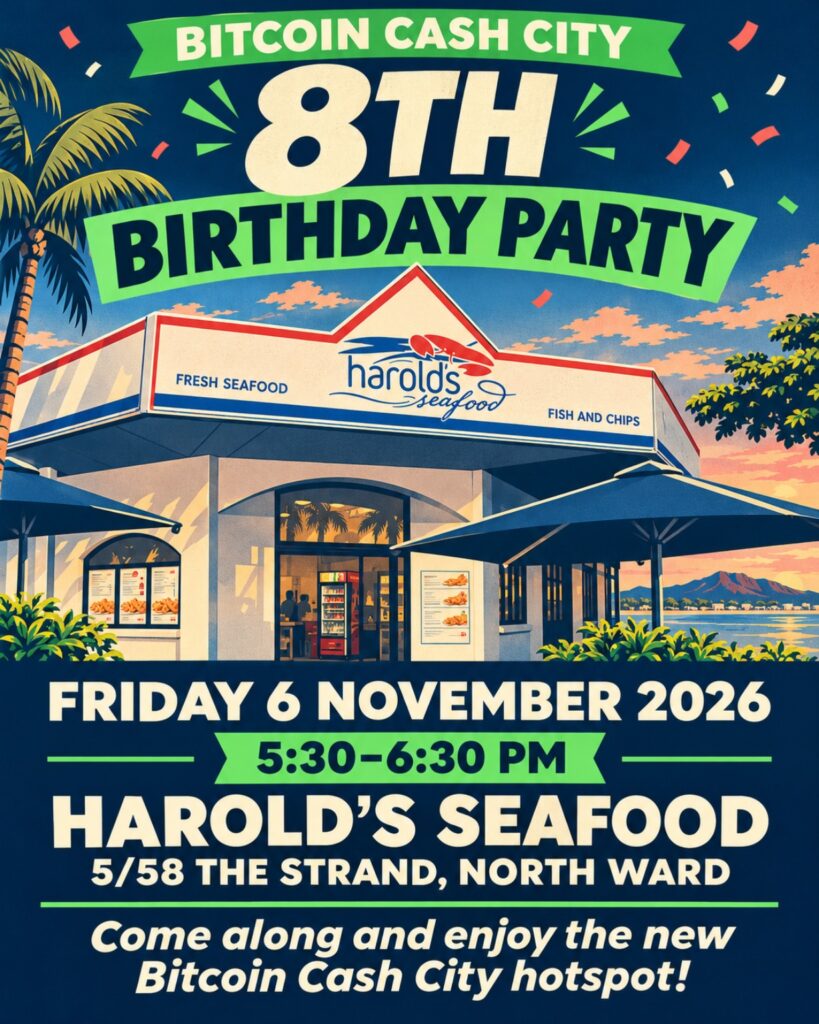
    Bitcoin Cash City 8th Birthday Party illustrated flyer for Harold's Seafood, 5/58 The Strand, North Ward, Friday 6 November 2026, 5:30–6:30 pm.
    Original Bitcoin Cash City eighth-birthday meetup invitation, Harold’s Seafood, Townsville, 6 November 2026.

    A small group of Bitcoin Cash supporters came together in Townsville on Friday evening to celebrate Bitcoin Cash City’s eighth birthday, reconnect after a long gap between meetups and talk about what comes next for peer-to-peer electronic cash in North Queensland.

    There were no grand announcements or packed conference halls. Just familiar faces, a conversation about local businesses and one practical ambition: make it easier for residents and visitors to spend Bitcoin Cash in everyday life.

    One street, several merchants, a stronger Bitcoin Cash economy

    The idea discussed at the gathering was simple: rather than having a handful of BCH-accepting businesses scattered across town, why not grow a walkable merchant hotspot around The Strand and Gregory Street?

    Imagine arriving in Townsville from the United States, Spain, Indonesia or elsewhere with BCH in your wallet. You could grab fish and chips, buy a coffee, stop for an ice cream and visit nearby shops without having to hunt across the city for the next business that accepts it.

    That concentration matters. One merchant gives customers a reason to try Bitcoin Cash. Several merchants close together give people a reason to visit, explore, stay longer and return.

    It also gives participating businesses something they can promote together: a place where peer-to-peer electronic cash is not a theoretical experiment, but an ordinary checkout option.

    From The Strand to the world

    There is another potential benefit for small businesses: international word of mouth. Travellers who use cryptocurrency often enjoy sharing real-world spending experiences through social media, videos and blogs.

    A visitor recording a BCH purchase at a modest Townsville shop could introduce that business to an audience overseas. A travel vlog, community post or specialist publication might carry a local merchant’s story far beyond North Queensland. That exposure is a possibility, not a guarantee, but it is another way BCH acceptance can help a business stand apart.

    For merchants, direct wallet-to-wallet payments can also reduce reliance on percentage-based card processing, although blockchain network fees, conversion costs and any optional payment-provider charges still need to be considered. For international customers already holding BCH, direct payments offer another option alongside conventional cards and currency conversion.

    A meetup about using Bitcoin Cash, not just talking about its price

    The evening included conversations about practical BCH wallets, including Paytaca, Selene and the Bitcoin.com Wallet. The work of BCH developers in the Philippines, particularly the Paytaca team, was also part of the discussion.

    Just as importantly, the meetup provided an opportunity to make and observe real payments. A purchase involving Harold’s Seafood, a BCH-friendly merchant near The Strand and Gregory Street, highlighted why clear payment requests and simple merchant confirmation matter.

    A separate BitcoinJason.com follow-up will look more closely at practical wallet user experience and merchant point-of-sale challenges. Developers deserve accurate, constructive feedback grounded in real transactions, not rushed conclusions from a single night.

    Growing the hotspot means helping merchants thrive

    The aim is not to persuade a shop to put a Bitcoin Cash sticker in the window and then disappear. Merchant adoption works best when shop owners and their staff are supported: setting up the right wallet or checkout method, learning how to request and verify a payment, and making sure customers know BCH is welcome.

    Printed payment QR codes can be reliable backups, especially where a dedicated tablet might be left uncharged between infrequent crypto purchases. But a smooth merchant experience also needs clear payment amounts, independent confirmation and useful records for the shop’s daily takings.

    Accurate merchant directories matter as well. A useful Bitcoin Cash map should make it easier to discover businesses that are still trading and genuinely accepting BCH, while removing or updating outdated listings.

    Eight years in, the work is still local

    Friday’s gathering was modest in size, which was not unusual for the first meetup in quite some time. But the focus was tangible: supporting merchants, making BCH easier to use and building a precinct where each new participating business adds value to those already there.

    The official Bitcoin Cash City news page has previously described the Gregory Street merchant hotspot and a wider precinct initiative near The Strand. The community discussion on 6 November centred on how to turn that idea into something visitors and residents can experience day to day.

    The next chapter of Bitcoin Cash City will not be measured only by how many people attend a meetup. It will also be measured by how easily somebody can walk into a local business, pay for an ordinary purchase and walk away with a good experience.

    Get involved

    If you live in Townsville, consider visiting a business that accepts Bitcoin Cash, thanking the merchant for offering another payment option and introducing a friend to a simple peer-to-peer purchase. If you own a business, start by learning how a small BCH payment works and whether it fits your checkout process.

    For community updates and participating merchants, visit Bitcoin Cash City. For more local reporting, practical onboarding ideas and follow-up articles, keep an eye on BitcoinJason.com.

    Reporting by Bitcoin Jason from the 6 November 2026 meetup. This article describes community discussion and firsthand observations; it does not imply all suggested merchant integrations or precinct plans are already in place.

  • Paraguay’s Ueno Bank Collapse: What Happened and Why Bitcoin Cash Self-Custody Matters

    Paraguay’s Ueno Bank Collapse: What Happened and Why Bitcoin Cash Self-Custody Matters

    Published 6 November 2026 | Bitcoin Jason News | Paraguay / Banking / Bitcoin Cash

    Nearly three million customers, a major bank placed into resolution, and urgent questions about public money: Paraguay’s Ueno Bank crisis has become a stark reminder of what happens when people depend on a financial institution to access their wages, savings and payments. Here is what the verified reporting says, what is still uncertain and why Bitcoin Cash supporters are paying attention.

    What happened to Ueno Bank?

    On 2 November 2026, the Central Bank of Paraguay (BCP) unanimously ordered Ueno Bank into a formal resolution process. In an announcement published on 3 November, it said adjustments to the bank’s financial statements revealed that its solvency ratio had fallen below 50% of the minimum required level. Resolution is a legal process for dealing with a troubled bank; it does not mean all deposits have vanished.

    Ueno grew rapidly as a digital lender. Reuters reported that the bank claimed approximately three million customers and handled around US$850 million in public funds. These figures describe the bank’s scale and public-sector exposure, not a confirmed final loss to customers or taxpayers.

    Customers faced disruptions to their banking services and access to accounts. People, including pensioners, gathered outside branches seeking answers. The trouble also brought intense attention to regulatory oversight, the bank’s lending practices and political ties.

    Is Paraguay’s entire banking system collapsing?

    No, that is not what the regulator has announced. The BCP calls this a case involving a particular institution and says it should not be taken as evidence that the country’s entire banking sector is insolvent. Social-media clips can convey the fear and frustration on the streets, but the distinction between one failed bank and a countrywide financial collapse matters.

    Are customers getting their deposits back?

    Paraguay has a statutory deposit guarantee. In its original resolution notice, the BCP stated coverage of up to 75 minimum monthly wages per depositor, per institution, subject to the relevant legal conditions. The BCP quoted an equivalent limit of ₲228.3 million at that time.

    On 5 November, the regulator announced the first group of guarantee repayments. That initial phase covers depositors with balances of up to ₲10 million, no outstanding debts to Ueno and an account at another Paraguayan bank or finance company. Further groups are to be announced. This is a changing process, and it would be inaccurate to claim that everyone has permanently lost their savings.

    For affected Ueno customers, the sensible starting point is the BCP’s official deposit-guarantee information, not messages circulating on social media. Be alert for fake recovery links and anyone claiming to need passwords or recovery phrases to release funds.

    The political controversy

    The crisis has also triggered investigations and political turmoil. Associated Press reporting describes questions about lending and financial disclosures, arrests of bank-linked executives, and calls for President Santiago Peña’s removal. Peña has denied wrongdoing. The president’s prior business connection to the group associated with Ueno has become a major focus of public debate. These are matters for investigators, courts and the political process; allegations should not be presented as proven criminal findings.

    The Bitcoin Cash question: Who controls your money?

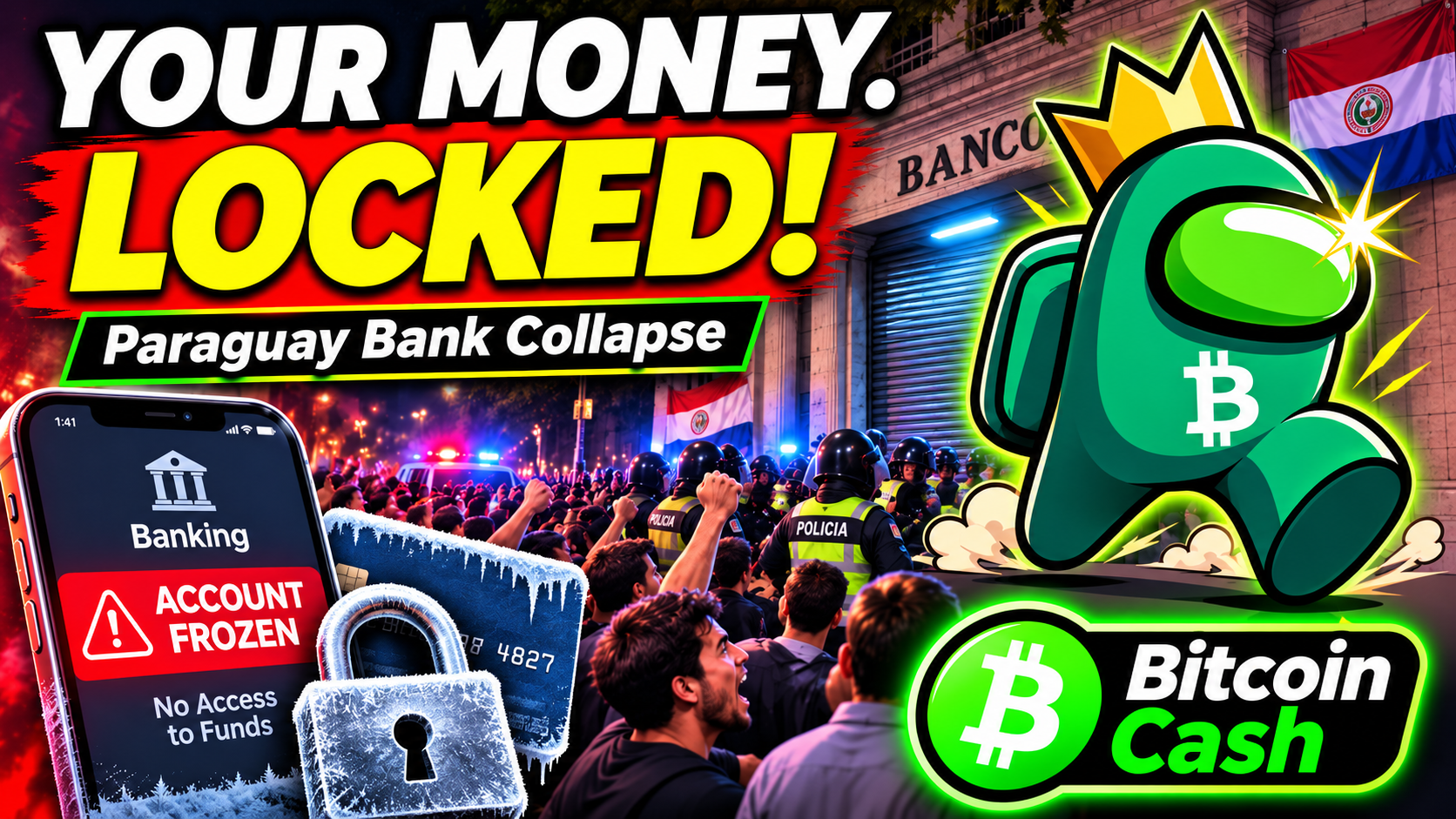
    Bitcoin Jason crowned green mascot with Bitcoin Cash symbol

    I’m Bitcoin Jason, a Bitcoin Cash advocate and merchant curator in Townsville, Queensland. For me, the central lesson is not that every bank is about to fail. It is that access and ownership are different questions. Money in a bank account is a claim on an institution operating within a financial and regulatory system. That system can provide useful safeguards, but it also creates dependencies.

    With Bitcoin Cash (BCH) in a properly secured self-custodial wallet, you hold the private keys needed to authorise transactions. Payments can move directly from sender to recipient on the Bitcoin Cash network without asking a bank to process that particular transfer. BCH was built with an emphasis on low-fee, peer-to-peer electronic cash, including small everyday purchases.

    This is particularly powerful when both customers and merchants have wallets and willingly transact in BCH. A local business can receive payment directly, and a customer can pay without waiting for a bank card network to process the transaction. That is one reason I work to grow real merchant adoption through the Bitcoin Cash City community.

    Self-custody is not a magic shield

    Bitcoin Cash is an alternative payment and custody model, not a guaranteed safe replacement for every bank account. BCH has market-price volatility; cryptocurrency transactions are generally irreversible; losing a recovery phrase or exposing your private keys can mean losing funds; and an exchange that holds BCH for you introduces its own custodial risk. BCH payments also depend on devices, access to the network and a merchant willing to accept them.

    The practical message is financial resilience through education and options. Learn how self-custody works, take sensible precautions, and understand the trade-offs before committing money.

    Bitcoin Cash wallets: Practical resources

    If you want to learn how to hold and spend BCH directly, start with the official wallet projects below. Read our full Bitcoin Cash Wallet Resources guide for descriptions, safety steps and official download links.

    • Paytaca: a self-custodial BCH wallet with merchant and CashTokens features.
    • Selene Wallet: a simple non-custodial BCH wallet for straightforward peer-to-peer payments.
    • Bitcoin.com Wallet: a self-custody multi-asset wallet supporting BCH, among other assets.
    • Electron Cash: an advanced BCH SPV wallet, particularly useful for desktop users and additional control.

    Electron Cash and CashFusion: A privacy feature worth knowing

    Bitcoin Cash transactions are recorded on a public blockchain, so financial privacy deserves attention. CashFusion is an optional collaborative privacy protocol available in compatible wallets, including Electron Cash. It combines inputs and outputs from multiple participants in joint transactions, making it harder to infer which coins belong to which user. This is not a promise of complete anonymity, and users should understand what it does and does not protect.

    Learn more from the project itself: How CashFusion works and CashFusion FAQs. Privacy tools and wallet compatibility can change, so check official documentation.

    Where this story goes next

    Bitcoin Jason News will continue following developments in the Ueno Bank resolution: when additional guarantee-payment groups are processed, what investigators establish about the bank’s finances, how depositors and public institutions are affected, and what lessons ordinary people can draw about the risks of financial intermediaries.

    My question to readers: If your bank stopped processing payments tomorrow, would you have another safe, practical way to pay for something essential?

    Primary sources and further reading

    Reporting current to 6 November 2026 (AEST). Facts, deposit payment arrangements and legal proceedings may change. Bitcoin Jason provides editorial commentary and education, not personal investment, financial or legal advice. Images are editorial illustrations, not authentic crisis photographs.

    Explore more: Bitcoin Jason News · BCH Wallet Resources · About Bitcoin Jason