Published 6 November 2026 | Bitcoin Jason News | Paraguay / Banking / Bitcoin Cash
Nearly three million customers, a major bank placed into resolution, and urgent questions about public money: Paraguay’s Ueno Bank crisis has become a stark reminder of what happens when people depend on a financial institution to access their wages, savings and payments. Here is what the verified reporting says, what is still uncertain and why Bitcoin Cash supporters are paying attention.
What happened to Ueno Bank?
On 2 November 2026, the Central Bank of Paraguay (BCP) unanimously ordered Ueno Bank into a formal resolution process. In an announcement published on 3 November, it said adjustments to the bank’s financial statements revealed that its solvency ratio had fallen below 50% of the minimum required level. Resolution is a legal process for dealing with a troubled bank; it does not mean all deposits have vanished.
Ueno grew rapidly as a digital lender. Reuters reported that the bank claimed approximately three million customers and handled around US$850 million in public funds. These figures describe the bank’s scale and public-sector exposure, not a confirmed final loss to customers or taxpayers.
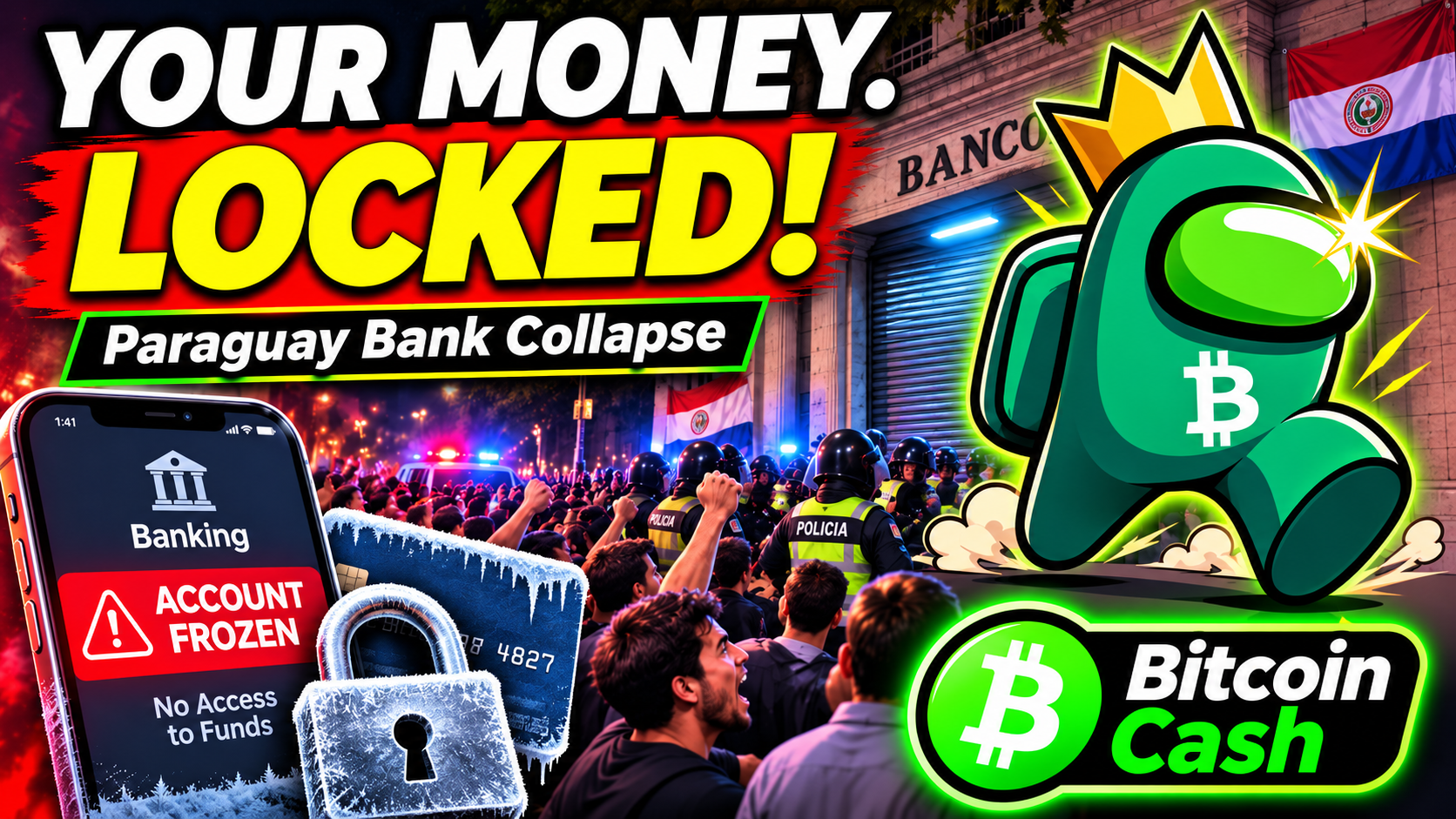
Customers faced disruptions to their banking services and access to accounts. People, including pensioners, gathered outside branches seeking answers. The trouble also brought intense attention to regulatory oversight, the bank’s lending practices and political ties.
Is Paraguay’s entire banking system collapsing?
No, that is not what the regulator has announced. The BCP calls this a case involving a particular institution and says it should not be taken as evidence that the country’s entire banking sector is insolvent. Social-media clips can convey the fear and frustration on the streets, but the distinction between one failed bank and a countrywide financial collapse matters.
Are customers getting their deposits back?
Paraguay has a statutory deposit guarantee. In its original resolution notice, the BCP stated coverage of up to 75 minimum monthly wages per depositor, per institution, subject to the relevant legal conditions. The BCP quoted an equivalent limit of ₲228.3 million at that time.
On 5 November, the regulator announced the first group of guarantee repayments. That initial phase covers depositors with balances of up to ₲10 million, no outstanding debts to Ueno and an account at another Paraguayan bank or finance company. Further groups are to be announced. This is a changing process, and it would be inaccurate to claim that everyone has permanently lost their savings.
For affected Ueno customers, the sensible starting point is the BCP’s official deposit-guarantee information, not messages circulating on social media. Be alert for fake recovery links and anyone claiming to need passwords or recovery phrases to release funds.
The political controversy
The crisis has also triggered investigations and political turmoil. Associated Press reporting describes questions about lending and financial disclosures, arrests of bank-linked executives, and calls for President Santiago Peña’s removal. Peña has denied wrongdoing. The president’s prior business connection to the group associated with Ueno has become a major focus of public debate. These are matters for investigators, courts and the political process; allegations should not be presented as proven criminal findings.
The Bitcoin Cash question: Who controls your money?
I’m Bitcoin Jason, a Bitcoin Cash advocate and merchant curator in Townsville, Queensland. For me, the central lesson is not that every bank is about to fail. It is that access and ownership are different questions. Money in a bank account is a claim on an institution operating within a financial and regulatory system. That system can provide useful safeguards, but it also creates dependencies.
With Bitcoin Cash (BCH) in a properly secured self-custodial wallet, you hold the private keys needed to authorise transactions. Payments can move directly from sender to recipient on the Bitcoin Cash network without asking a bank to process that particular transfer. BCH was built with an emphasis on low-fee, peer-to-peer electronic cash, including small everyday purchases.
This is particularly powerful when both customers and merchants have wallets and willingly transact in BCH. A local business can receive payment directly, and a customer can pay without waiting for a bank card network to process the transaction. That is one reason I work to grow real merchant adoption through the Bitcoin Cash City community.
Self-custody is not a magic shield
Bitcoin Cash is an alternative payment and custody model, not a guaranteed safe replacement for every bank account. BCH has market-price volatility; cryptocurrency transactions are generally irreversible; losing a recovery phrase or exposing your private keys can mean losing funds; and an exchange that holds BCH for you introduces its own custodial risk. BCH payments also depend on devices, access to the network and a merchant willing to accept them.
The practical message is financial resilience through education and options. Learn how self-custody works, take sensible precautions, and understand the trade-offs before committing money.
Bitcoin Cash wallets: Practical resources
If you want to learn how to hold and spend BCH directly, start with the official wallet projects below. Read our full Bitcoin Cash Wallet Resources guide for descriptions, safety steps and official download links.
- Paytaca: a self-custodial BCH wallet with merchant and CashTokens features.
- Selene Wallet: a simple non-custodial BCH wallet for straightforward peer-to-peer payments.
- Bitcoin.com Wallet: a self-custody multi-asset wallet supporting BCH, among other assets.
- Electron Cash: an advanced BCH SPV wallet, particularly useful for desktop users and additional control.
Electron Cash and CashFusion: A privacy feature worth knowing
Bitcoin Cash transactions are recorded on a public blockchain, so financial privacy deserves attention. CashFusion is an optional collaborative privacy protocol available in compatible wallets, including Electron Cash. It combines inputs and outputs from multiple participants in joint transactions, making it harder to infer which coins belong to which user. This is not a promise of complete anonymity, and users should understand what it does and does not protect.
Learn more from the project itself: How CashFusion works and CashFusion FAQs. Privacy tools and wallet compatibility can change, so check official documentation.
Where this story goes next
Bitcoin Jason News will continue following developments in the Ueno Bank resolution: when additional guarantee-payment groups are processed, what investigators establish about the bank’s finances, how depositors and public institutions are affected, and what lessons ordinary people can draw about the risks of financial intermediaries.
My question to readers: If your bank stopped processing payments tomorrow, would you have another safe, practical way to pay for something essential?
Primary sources and further reading
- Banco Central del Paraguay: official Ueno resolution announcement, 3 November 2026 (Spanish).
- Banco Central del Paraguay: start of deposit guarantee payments, 5 November 2026 (Spanish).
- Banco Central del Paraguay: official deposit guarantee payment information.
- Reuters: What is Ueno Bank and how did it trigger Paraguay’s political crisis?, 5 November 2026.
- Associated Press: Paraguay president and Ueno Bank developments.
- CashFusion: official project site.
Reporting current to 6 November 2026 (AEST). Facts, deposit payment arrangements and legal proceedings may change. Bitcoin Jason provides editorial commentary and education, not personal investment, financial or legal advice. Images are editorial illustrations, not authentic crisis photographs.
Explore more: Bitcoin Jason News · BCH Wallet Resources · About Bitcoin Jason
Leave a Reply