A falling Aussie dollar can lift Bitcoin Cash’s local price—even when BCH has not gained against the US dollar. Understanding that difference helps you judge what your money is really doing.
By Bitcoin Jason · 19 November 2026
When a headline says the Australian dollar has fallen below US67 cents, it is reasonable to wonder whether Bitcoin Cash should do well against it. There is a real exchange-rate effect working in BCH’s favour: an unchanged US-dollar value translates into more Australian dollars.
Whether you actually gain depends on how BCH itself performs, the period you measure, and what happens to the prices of the things you buy.
What the latest Australian figures tell us
The Australian Bureau of Statistics reported on 19 November that October’s seasonally adjusted unemployment rate was 4.9%, while employment fell by 43,500 people. These figures describe the labour market; they do not predict BCH’s next move. Source: ABS October 2026 Labour Force release.
The Reserve Bank of Australia’s daily exchange-rate table recorded A$1 = US$0.6677 on 19 November 2026. That is approximately 66.77 US cents for one Australian dollar. This is a dated reference rate, rather than a live trading quote. Source: RBA exchange rates.
How a weaker AUD changes BCH’s Australian price
AUD/USD tells you how many US dollars one Australian dollar buys. If the rate falls from 0.70 to 0.67, each Aussie dollar buys fewer US dollars. An asset with an unchanged US-dollar price therefore costs more in AUD. RBA guide to the AUD exchange rate.
BCH price in AUD = BCH price in USD ÷ AUD/USD exchange rate
For illustration, suppose one BCH is worth US$200. At an AUD/USD rate of 0.70, its equivalent price is A$285.71. At 0.67, the same coin is worth A$298.51. That is a 4.48% rise in AUD, even though its US-dollar price has not moved.
The conversion describes the relationship between the prices. You do not have to buy US dollars first to buy BCH. An Australian exchange’s actual quote can also differ because of spreads, fees and trading conditions.
Five scenarios: currency support and market risk
Every BCH price and exchange rate in the following table is hypothetical. Each percentage compares with the first row; none is a forecast or a current BCH quote.
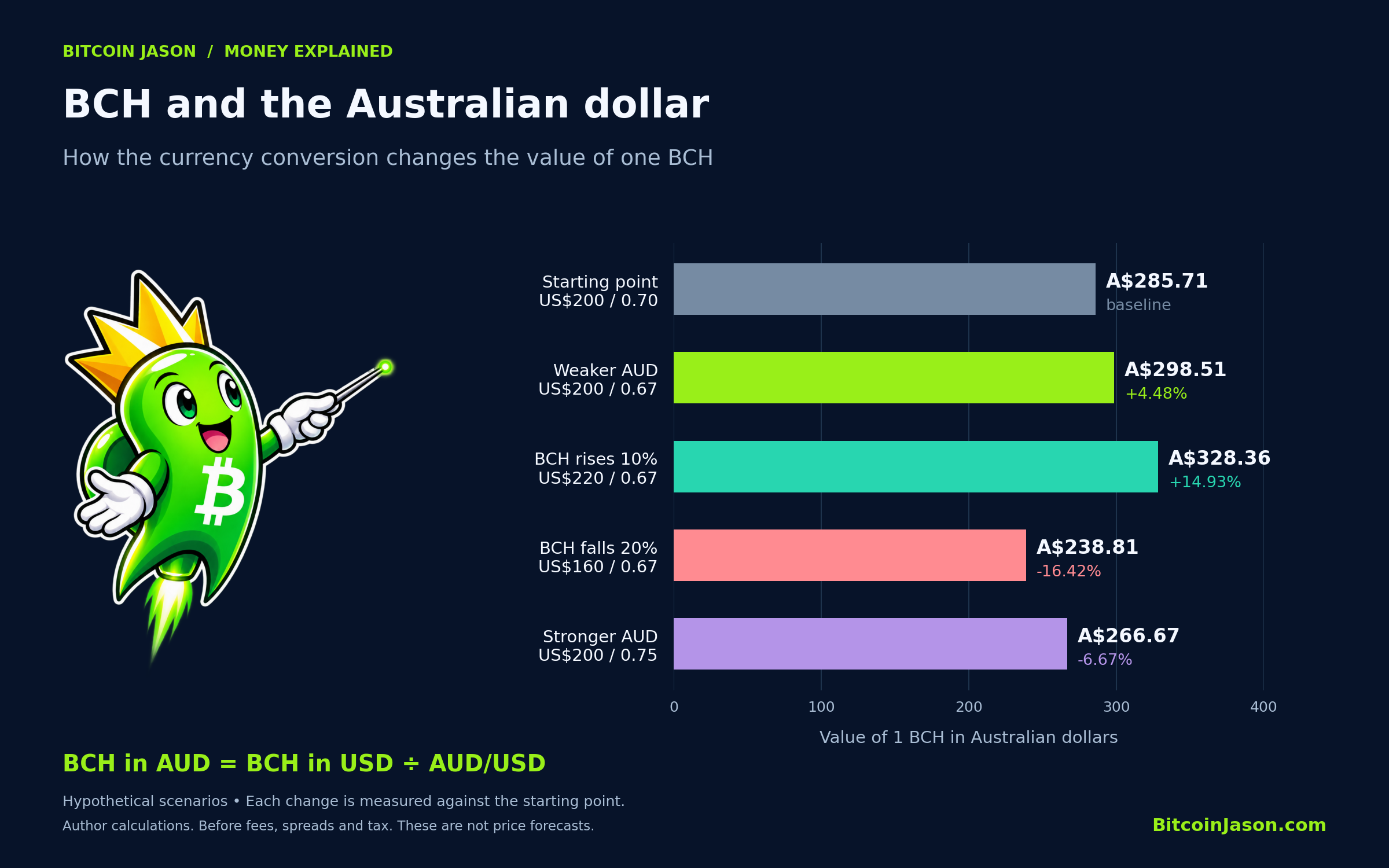
| BCH (US$) | AUD/USD | BCH (A$) | AUD change |
|---|---|---|---|
| 200.00 | 0.70 | 285.71 | Starting point |
| 200.00 | 0.67 | 298.51 | +4.48% |
| 220.00 | 0.67 | 328.36 | +14.93% |
| 160.00 | 0.67 | 238.81 | −16.42% |
| 200.00 | 0.75 | 266.67 | −6.67% |
Author calculations: divide each US-dollar BCH price by AUD/USD, then compare with the unrounded starting value. Results exclude fees, exchange spreads and tax.
The second row isolates the currency benefit. The third combines a 10% rise in BCH’s US-dollar price with a weaker AUD. In the fourth, a 20% BCH decline overwhelms that currency benefit: the Australian holder still loses 16.42%.
The final row shows the reverse effect. If the Australian dollar strengthens while BCH stays at US$200, BCH’s AUD price falls. Exchange rates can help or hinder your result.
Why weak economic news does not guarantee a BCH rally
Weaker employment can influence expectations about future interest rates. The RBA explains that relative interest rates, commodity prices and investors’ willingness to take risk all affect the Australian dollar. A jobs report is one part of that picture. It does not establish what the RBA will do next. Source: RBA exchange-rate drivers.
Meanwhile, BCH has its own buyers and sellers. ASIC’s Moneysmart explains that crypto prices can change sharply with investor opinion, perceived value, popularity and ease of use. Source: Moneysmart crypto guide.
One possible outcome is that worried investors sell both Australian dollars and crypto. Another is that BCH holds steady while the AUD falls. The headline alone cannot tell us which outcome will occur.
Where BCH’s limited supply fits into the argument
Under its current protocol rules, Bitcoin Cash has a maximum supply of 21 million BCH, with new coins issued on a schedule. Its design also supports payments directly between users over an open network. Those features help explain the appeal to people seeking another way to hold and transfer value. Source: Bitcoin Cash project website.
A supply limit does not set a minimum market price. People still have to want to acquire, hold or use BCH. Growing merchant use could contribute to demand; the effect on price depends on how people buy, spend and sell. Scarcity alone cannot promise an investment return.
An AUD gain and better buying power are different measures

A higher wallet balance in Australian dollars is a nominal gain. To measure purchasing power, compare it with the cost of the goods and services you need over the same period.
Suppose a holding rises from A$100 to A$110 while a basket of goods rises from A$100 to A$105. Your nominal gain is 10%, but your increase in buying power is approximately 4.76%: divide 110 by 105, then subtract one. This is an illustrative calculation, not Australia’s current inflation rate.
A fall against the US dollar is also different from Australian consumer-price inflation. A weaker AUD can increase import costs, but the RBA notes that businesses may pass those costs on gradually. A currency fall does not translate into an identical, immediate increase in every household bill. Source: RBA on exchange rates and the economy.
For a historical example, read Bitcoin Cash and the Australian Dollar, which compares BCH and idle cash after adjusting for changes in consumer prices.
What this means at a Townsville merchant

Imagine a Townsville shop prices a meal at A$25 and accepts BCH. At a hypothetical BCH price of A$300, the meal costs about 0.08333 BCH. At A$360 per BCH, it costs about 0.06944 BCH. The meal’s Australian-dollar price is unchanged; fewer coins are needed.
If the merchant keeps the BCH, its AUD value can change before the merchant spends or converts it. Accepting a payment and holding the proceeds involve different exposure to price movements.
As a merchant curator, I want people to have more choice in how they pay and trade. A useful BCH economy needs customers who use it and businesses that find it worthwhile to accept. That is work we can do locally, whatever today’s exchange rate.
When judging BCH’s performance, check three things: its price in Australian dollars, the dates being compared, and how much that balance can actually buy.
This article provides general education, not a personal investment recommendation. Figures are dated or explicitly hypothetical. Sources were checked on 19 November 2026.
Leave a Reply