What A$100 buys after inflation
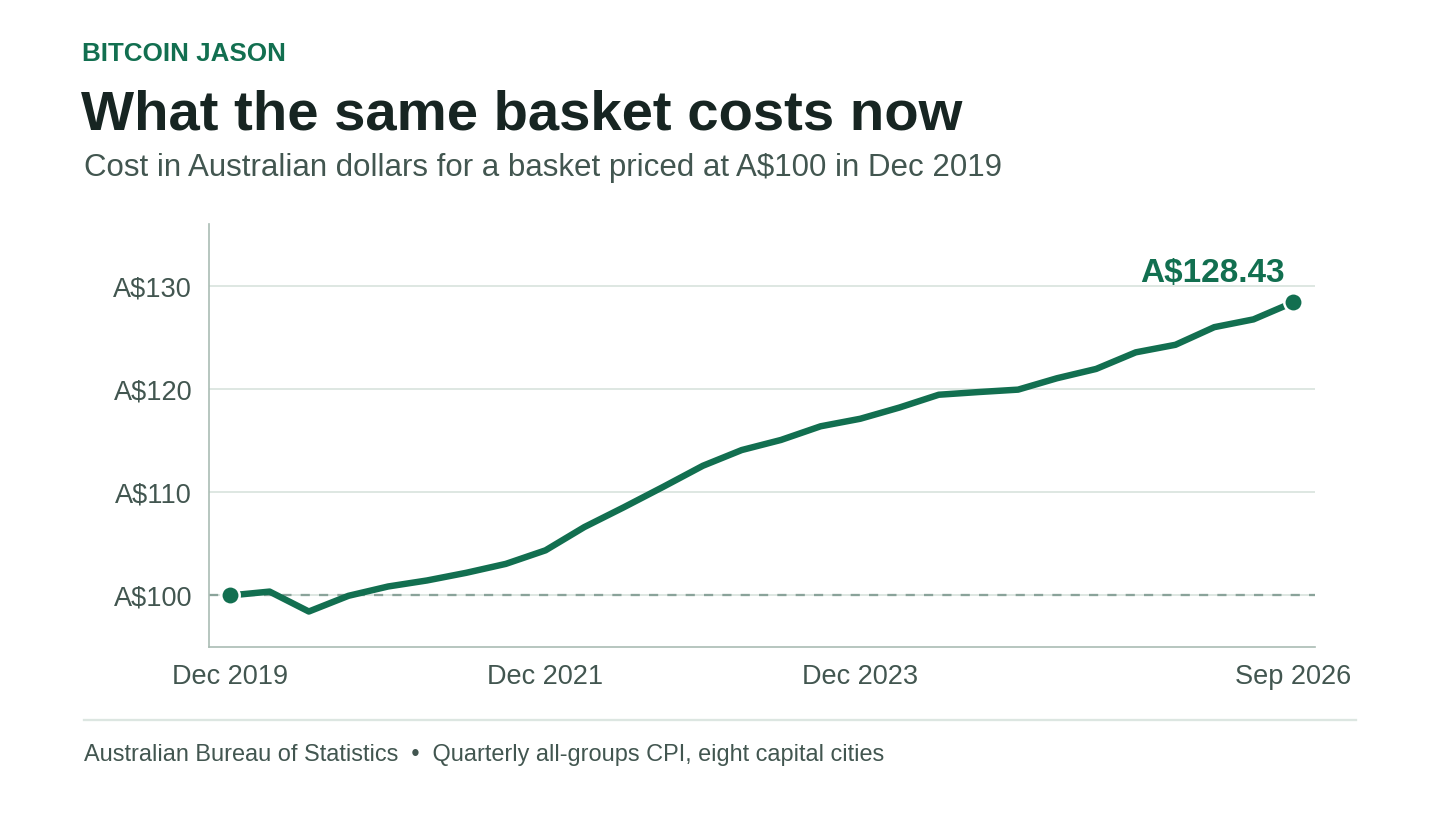
Imagine a basket of everyday goods and services that cost A$100 around the start of 2020. Based on Australia’s Consumer Price Index, a comparable basket would have cost about A$128 by the September quarter of 2026. Over the dates we’ll look at, Bitcoin Cash held on to a little more buying power than idle Australian dollars. Both had lost purchasing power by the end. ABS CPI release
Where Bitcoin Cash is trading
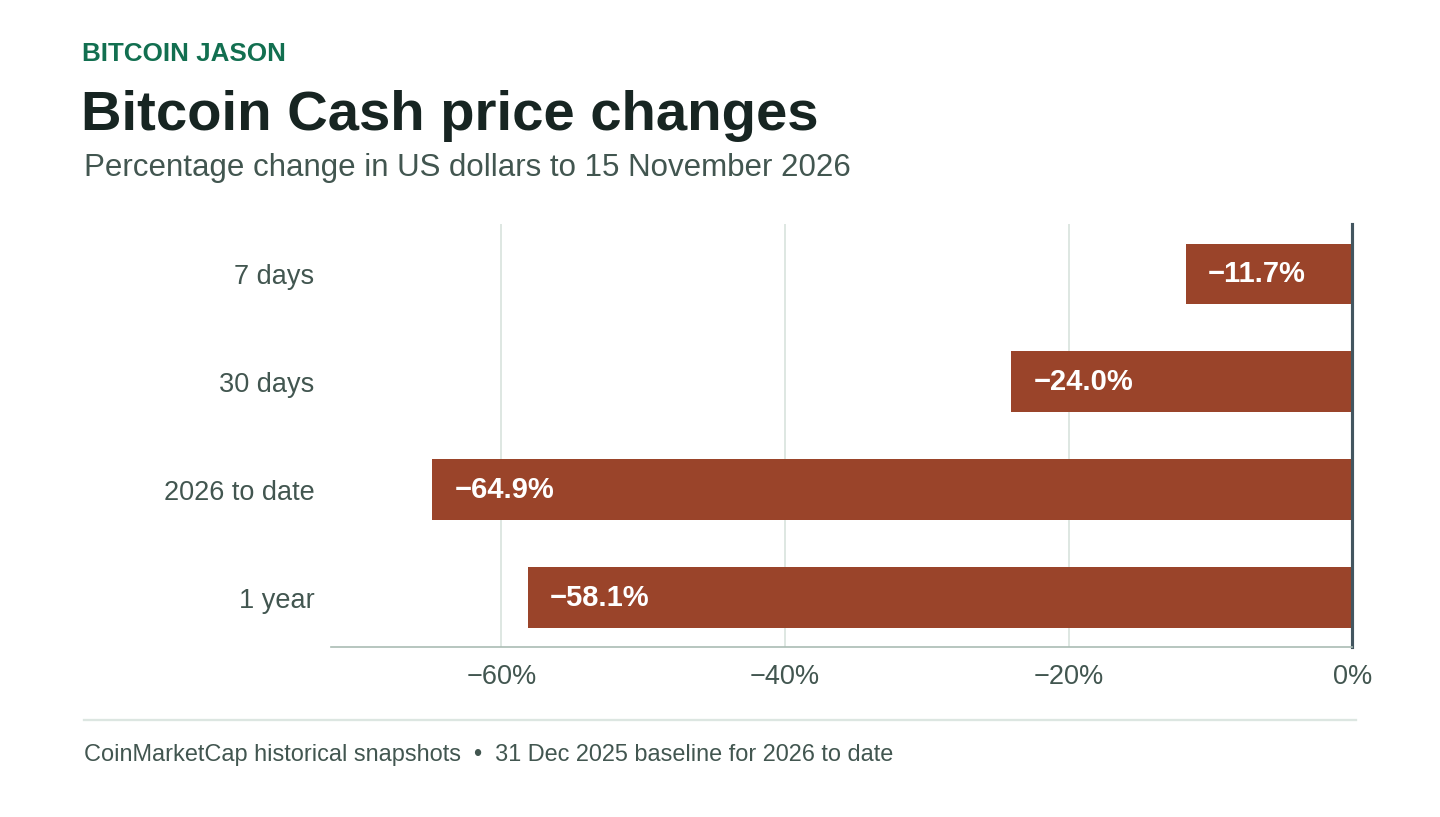
One Bitcoin Cash coin (BCH) was US$210.47 on 15 November, or about A$309 using the exchange rate from the preceding business day. About 20.12 million BCH were in circulation, for a market value of roughly US$4.23 billion. That figure, called market capitalisation, is the price per coin multiplied by the number in circulation. 15 November market snapshot
BCH bounced 4.8% in the final 24 hours of that snapshot and was still down 24.0% over 30 days. The chart compares the same US-dollar price with four earlier dates.
US funds that track Bitcoin (BTC), a separate cryptocurrency, recorded about US$1.07 billion in net outflows from 9 to 13 November. The Bitcoin-focused Fear & Greed Index read 10 out of 100 on 16 November, in extreme fear territory. Farside fund flows · Alternative.me sentiment index
How inflation changes what a dollar buys
The Australian dollar (AUD) is fiat money. It’s the official currency we use to price wages, rent and groceries, and its value relies on people trusting and accepting it. The supply of dollars can expand when banks lend and create new deposits. When prices rise, a fixed amount of cash buys less. That is a loss of purchasing power. RBA guide to money
The Australian Bureau of Statistics tracks changes in the price of a broad household basket with the Consumer Price Index, or CPI. Its headline measure averages eight capital cities. The mix of things you buy and where you live will shape the prices you actually face. The monthly CPI was up 4.3% over the year to September 2026. ABS CPI release
The Reserve Bank aims for inflation of 2–3% over time. Even a low positive rate means prices generally rise over the years. An economy running short of goods, or businesses facing higher power and transport costs, can push some prices up faster. RBA on what causes inflation
A price rise of 28.4% translates to about a 22.1% loss of buying power for idle cash. Divide A$100 by the new A$128.43 price and you can see why. The original A$100 now covers about 78% of the basket. Interest on savings can offset some of that loss.
What happened to a hundred dollars
On 1 January 2020, one BCH cost US$204.40, or about A$291 at the time. At about A$309 on 15 November 2026, its price was up 6.4% in Australian dollars. A weaker Australian dollar also helped lift the local price over these dates. 1 January 2020 snapshot · 15 November 2026 snapshot
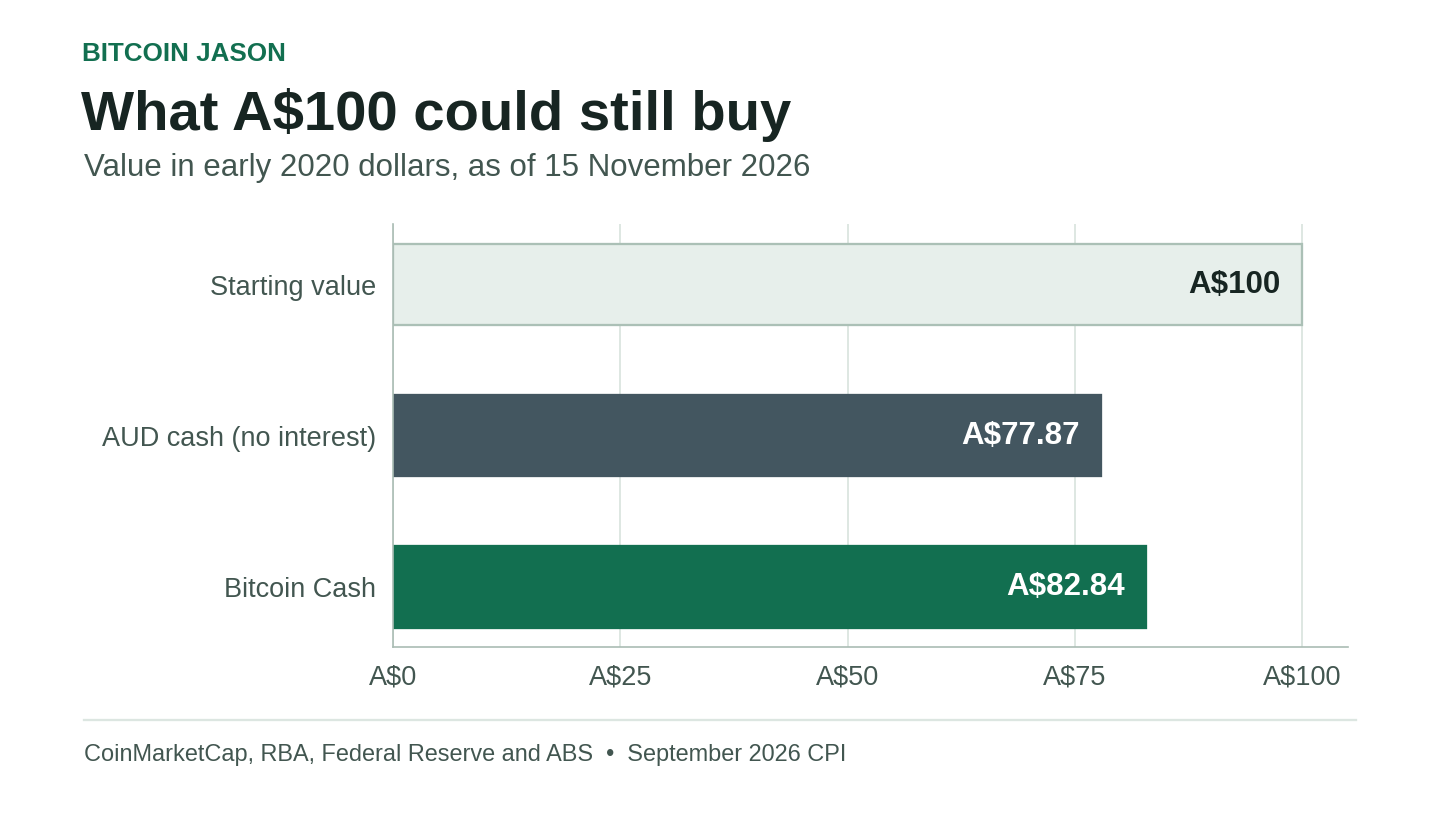
A$100 would have bought about 0.344 BCH on 1 January 2020. That fraction of a coin was worth about A$106 by 15 November 2026. The last column shows how much of the original basket each balance could still buy, measured in early 2020 dollars.
Over these dates, BCH lost 17.2% of its buying power. Australian cash earning no interest lost 22.1%.
| How you held it | End balance | In early 2020 dollars |
|---|---|---|
| AUD cash | A$100.00 | A$77.87 |
| Bitcoin Cash | A$106.39 | A$82.84 |
The example assumes cash earned zero interest and BCH was held throughout. Values are before fees, exchange spreads and tax.
Your result would have depended heavily on when you bought. On 30 April 2021, one BCH was about US$993. Someone who bought at that price had a very different experience. A fixed supply can make issuance predictable while the market price still moves sharply with demand. 30 April 2021 snapshot
How a Bitcoin Cash payment works
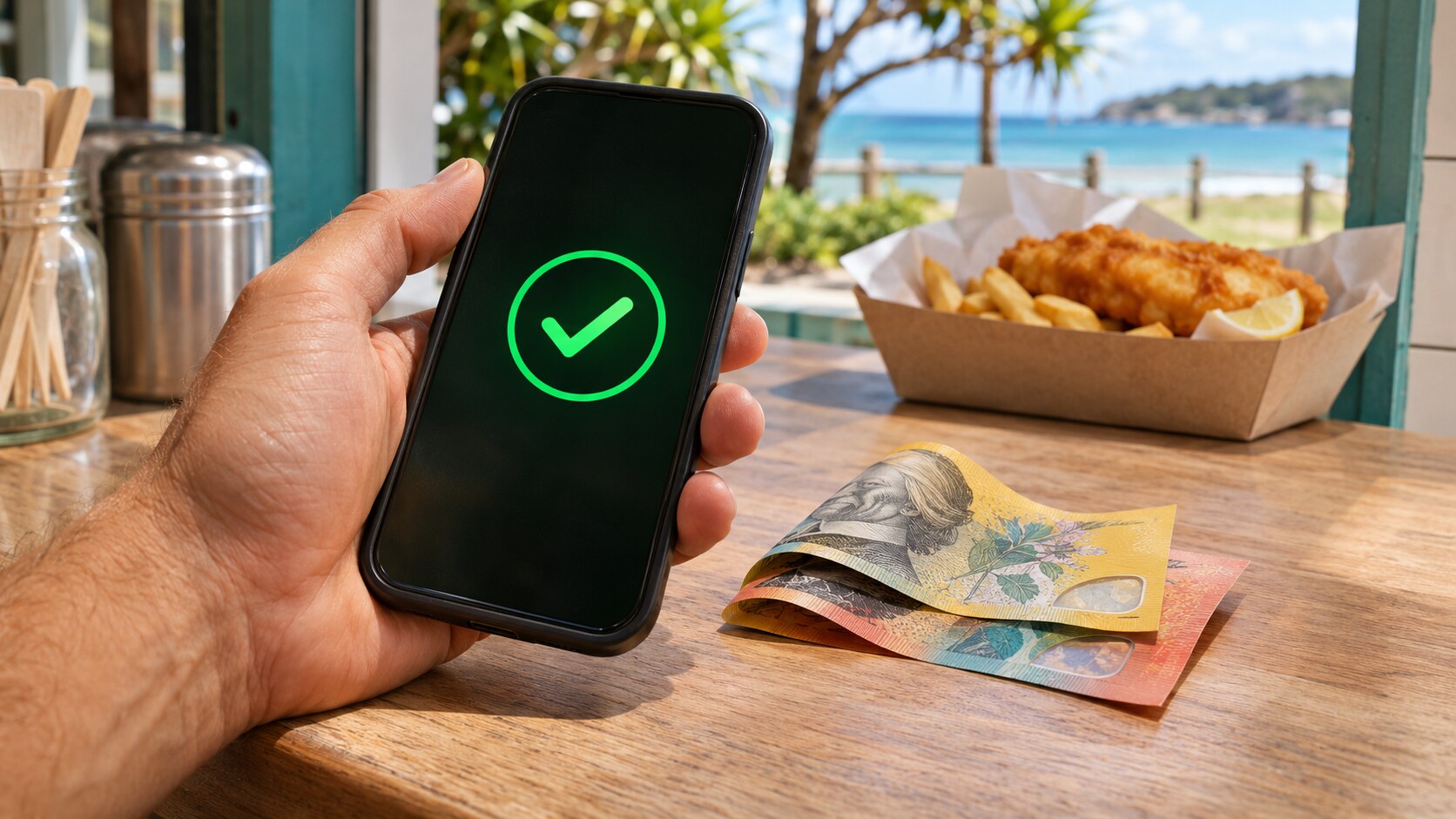
Say a fish-and-chip shop in Townsville takes BCH and your order is A$25. The till works out the equivalent in BCH and displays a QR code. Your wallet, the app you use to spend BCH, reads it and shows you the amount. When you press send, the payment goes from wallet to wallet over the Bitcoin Cash network, typically for a small fee. A confirmation comes when the network records the payment in a block, a batch of transactions on a public ledger. Bitcoin Cash block documentation
The network’s rules cap total supply at 21 million BCH. New coins are issued on a schedule. A wallet you control lets you send funds yourself, including across borders. Its recovery phrase can restore access and can also give anyone who sees it control of your funds. If you try a first payment, check the amount and recipient and start small. A mistaken payment generally requires the recipient to return it. BCH supply figures · Moneysmart on crypto wallets and risks
Faster confirmations and privacy
Bitcoin Cash currently targets one block about every ten minutes, with waiting times that vary. The Faster Blocks proposal would bring that target down to one minute. Ahead of the 15 November coordination milestone, Bitcoin Cash Node maintainers committed to implementing it and shared preview software for testing. The target for the live network is 15 May 2027. Wallets and exchanges that assume ten-minute blocks would need to adapt. Bitcoin Cash Node announcement · Faster Blocks proposal discussion
Bitcoin Cash transactions appear on a public ledger. CashFusion, available in wallets such as Electron Cash and Stack Wallet, brings several users’ coins into a single transaction to make their histories harder to link. Users keep control of their keys, and tracing can still be possible. How CashFusion works · Supported CashFusion wallets
CashTokens let applications create and transfer tokens on Bitcoin Cash, such as a unique digital ticket. The May 2026 upgrade gave unique tokens room to carry more data. A separate research proposal explores ways to sign transactions that could resist attacks by future quantum computers. CashTokens specification · May 2026 upgrade · Post-quantum signature proposal
As a merchant curator in Townsville, I’m interested in whether a local shop can take a payment simply and decide how to handle the proceeds. That gives customers and businesses another way to trade. Holding BCH for longer brings a different decision about how much price movement you can live with while still paying the bills.
This article is general education. Market prices change continuously.
How the figures were calculated
CoinMarketCap provided the US-dollar prices. The preceding business-day exchange rates were US$0.7030 per A$1 on 31 December 2019 and US$0.6804 on 13 November 2026. The ABS all-groups quarterly CPI was 80.70 in December 2019 and 103.64 in September 2026, the latest available quarter. Federal Reserve AUD/USD data · RBA daily exchange rates, Table F11.1 · ABS quarterly CPI, Table 17 · September quarterly index
Leave a Reply